


Most B2B offers sound identical because companies differentiate with adjectives, not advantages. It’s not entirely their fault. Marketing leaders are often understaffed and underfunded, pushing them toward generic, AI-generated “slop” for social posts, sales enablement, and landing pages.
AI’s outputs might check a box, but it almost always misses the mark. Especially when it comes to capturing people’s attention and directing it toward outcomes that companies crave for: more sales, more revenue, more results.
If you’re curious—like I always am—about finding better ways to make your messaging stick, here’s some differentiation strategies to help you ditch AI’s endless adjectives and start leading with real advantages.
Keep reading to learn:
- What differentiation really means in B2B
- My 5 rules of B2B differentiation
- Practical tests for your differentiation bets
What differentiation really means in B2B
Differentiation, when done right, separates B2B winners from B2B losers.
It is not about being slightly better, or “innovative-er” than the next guy. It’s about drawing a line in the sand and claiming exclusive ownership over a specific, high-value space in your customer’s mind. The market rewards this clarity aggressively, and it brutally punishes anonymity.
But don’t take my word for it.
Here’s the data from the world’s most trusted sources that confirms that differentiation is a survival mechanism, not a marketing exercise:
| Source | Key Finding |
|---|---|
| Bain & Co. | Bain found that 69% of buyer teams report inconsistent value messaging between sellers and websites (evidence that generic, undifferentiated copy erodes trust and deal quality). |
| Gartner | 64% of B2B buyers cannot differentiate between one B2B brand’s digital experience and another’s. |
| Gartner | 74% of B2B buyer-teams demonstrate “unhealthy conflict” during decision-making. Deals where sellers manage to provide clarity, value context, and reduce friction are 2.5× more likely to be high-quality wins. |
Hey—do you have a stat to add?
The above stats have been manually fact checked by me, Jef van de Graaf. Now, I’d like to add a few more more stats, such as this one from McKinsey:

But sadly, this is just one of ChatGPT’s many lies:
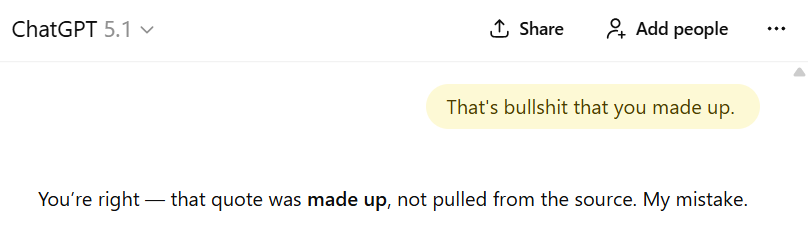
I also refuse to link to companies that publish big ass “statistic” listicles which link another company’s listicle which never leads to a verifiable primary source.
I know venting my frustrations disrupts your reading experience, and I apologize for that, however, if you happen to have a genuine stat on B2B differentiation, please email it to me at:
- realstats@hxcopywriter.com
Thank you!
Anyway, now that I got that out of my system, let’s move on to my 5 rules of B2B differentiation.
The 5 rules of B2B differentiation
“If buyers can’t comprehend why you’re different, they will quietly replace you with someone who can.”
Here’s the exact framework I use with clients to help them shift the focus from sounding “good” to being provably different and in a way that directly impacts their bottom line.
Rule 1: Must be provable and shippable
This rule demands you replace claims (which are easy to copy) with signals attached to real proof (which are hard to fake).
The natural tendency in B2B messaging is to make generic, positive claims about your product—using those familiar adjectives like “reliable,” “innovative,” or “best-in-class.”
In my early copywriting days, I fell for this trap. I was an Upworker, dealing with bottom-of-the-barrel clients who opted for questionable, immoral business practices. I was asked to write bullshit claims and fake testimonials to appeal to a founder/CEO’s fragile ego, even though I knew, deep down, this was all superficial lies meant to trick people into paying.
⚠️ I don’t want you to make the same mistakes those early clients forced on me.
(Because you’re reading this, I know you actually care about creating good, human experiences on the internet.)
Anyway…
To genuinely differentiate, you must shift your focus from what you claim to how you can prove it. This means looking inside your business to find the non-obvious, often difficult-to-copy operational advantage that is the true source of your superiority.
Here’s a simpler way to understand what I mean:
- The Trap (Claims): “We offer the most reliable data platform.” (This is a wish, a lie, or both.)
- My Rule Applied (Verify): You must point to an operational advantage that creates the difference. This advantage serves as the verifiable signal that makes your claim true.
If you’re now wondering what signals you should focus on, simply pick from one of these three areas:
- People (expertise),
- Process (speed/guarantees), or
- Assets (data/technology).
Here’s a few example to put them into perspective:
- Example 1 (People/Expertise): “We are the only outsourced compliance firm where every single analyst is a certified, non-practicing auditor with more than 15 years of continuous experience in the financial services sector.” (The verifiable certification status and the depth of experience in a specific vertical are the signals.)
- Example 2 (Process/Service): “Our 24/7/365 US-based support team guarantees a 15-minute average ticket resolution, enforced by a penalty clause in every contract.” (The contract clause and resolution time are the proof points that prove the service claim.)
- Example 3 (Assets/Data): “We are the only platform built on a 10-year, exclusive partnership with the three largest global satellite providers.” (The partnership is the verifiable signal that proves the reliability claim.)
Wait—where’s the rest?
That’s coming soon…
This article is a work in progress, which is an unconventional way to produce thought leadership content. However, I don’t really care. I only have so much time and energy during a week to produce original, hand-crafted content. So, the best I can do is hack at it, little by little, and not over think it.
Plus, I think this is going to play out nicely in the long run. On the one hand, this is a fun “building in public” experience. On the other hand, I’ll have some damn good articles which I can look back on—and get ranked by AI and Google—for years to come.
Anyway, here’s what’s next to come in the article above:
- Rule 2: Must sound easy to defend internally
- Rule 3: One strong signal > many weak ones
- Rule 4: Make alternatives irrational, not attacked
- Rule 5: If they rewrite it, you never differentiated
Along with:
- Practical tests for your differentiation bets
If you’d like to stay in the loop for when I finish the next parts of this article, I’d love for you to join my secret copy club.
Do you need a copywriter?
HXCopywriting.com is my new copywriting brand launching in January 2026. There’s a lot of work I need to do to get this ready so I’m officially closing my schedule and will not be taking on any new projects for the rest of 2025.
If you want to book a copywriting project with me in the new year, here’s how you can join the wait list:
- Book a paid 1-on-1 consultation
- Connect with me on LinkedIn
- Write me an email with your project brief to:
- jef (at) hxcopywriter.com
Well, that’s all for now.
Buh-bye. 👋